Jump to Category
I. Introduction: A War Fought from the Ground Up
The Vietnam War produced one of the most sophisticated and psychologically devastating systems of improvised weaponry in the history of modern conflict. Faced with an adversary possessing overwhelming technological superiority (air power, artillery, armored vehicles, and virtually limitless materiel), the Viet Cong (VC) and North Vietnamese Army (NVA) turned the land itself into a weapon. Booby traps and improvised devices became a cornerstone of their asymmetric strategy, designed not merely to kill, but to wound, to slow, to terrorize, and to exhaust an enemy that could not be defeated in open battle.
Estimates from U.S. Army records suggest that booby traps accounted for somewhere between eleven and seventeen percent of all American casualties in Vietnam, depending on the operational theater and time period. In certain regions, particularly the heavily contested Cu Chi district, the Iron Triangle, and the Mekong Delta, that figure climbed considerably higher. But the raw casualty numbers tell only part of the story. The true effect of the trap campaign was behavioral: American units operating in known trap-heavy areas slowed to a fraction of their normal patrol speed, became tactically predictable, and suffered a form of collective psychological attrition that no casualty statistic fully captures.
The traps described in this article span the full range of VC and NVA ingenuity, from ancient designs adapted from traditional hunting practices to sophisticated devices assembled from unexploded American ordnance. American bombs, quite literally, turned against American soldiers. They have been organized into eight categories based on their primary mechanism and tactical purpose. Each category heading links to a dedicated deep-dive article. This article serves as the master index to that series.
II. Pit TrapsDeep Dive →
6 Documented Variants
Pit traps are among the oldest weapons in human history, and the VC employed them with a sophistication that belied their apparent simplicity. Their placement was rarely random. Designers studied patrol routes, likely rest areas, and natural choke points to maximize the probability of contact. Every variant shared one defining feature: a surface disguised so thoroughly with native soil and vegetation that even trained combat dogs could not reliably detect them.
-
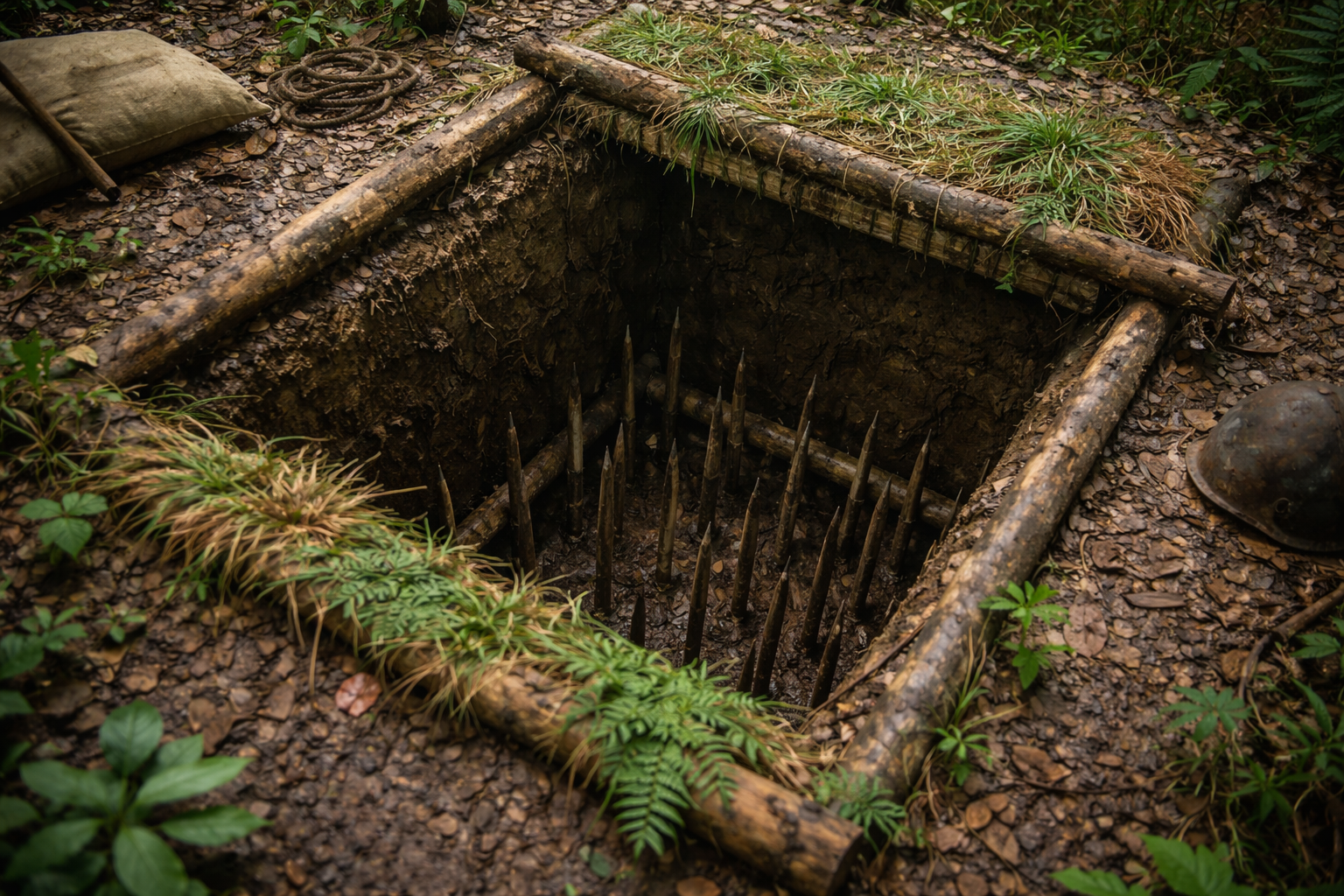 Photo
Photo
coming soonPunji PitThe most iconic trap of the war. A pit two to four feet deep, lined with inward-angled bamboo stakes smeared with feces or toxins to guarantee infection. The goal was rarely a clean kill. A badly infected wound requiring medevac removed a soldier from the field for weeks and consumed far more resources than a fatality.
-
 Photo
Photo
coming soonMace PitA standard pit combined with a counterweighted spiked ball suspended above the opening. When the cover gave way, the mace swung downward at velocity, striking the fallen soldier from above. The dual-threat design, fall first and struck second, was intended to complicate rescue and maximize the severity of wounds.
-
 Photo
Photo
coming soonStaircase PitSteps and floorboards were undermined and their supports partially cut so they appeared normal under inspection but collapsed under a soldier's weight, dropping the victim into a spiked pit below. Particularly common in abandoned villages during the later years of the war, when U.S. units regularly cleared civilian structures.
-
 Photo
Photo
coming soonCartridge Trap PitSpent casings fitted with live primers and nail firing pins, embedded point-up in a shallow depression. Stepping down drove the nail into the primer, firing the cartridge upward through the boot sole. Faster to construct than deep pits and easier to scatter across wide areas, these prioritized a crippling foot wound over a fatal fall.
-
 Photo
Photo
coming soonMud TrapFlooded pits of deep clay or mud, sometimes laced with debris or submerged stakes, that immobilized a soldier on contact. The primary danger was drowning if the victim could not free himself, or helpless exposure to enemy fire while pinned in place. The saturated terrain of the Mekong Delta made these especially practical.
-
 Photo
Photo
coming soonUnderwater Punji PitStakes driven into rice paddy beds and stream bottoms at known ford points, completely concealed by murky water. Soldiers wading across had no means of detecting them and could not react quickly enough in the water to avoid injury once they stepped in. A direct adaptation of the classic punji design for Vietnam's waterlogged lowland terrain.
III. Swing & Spring TrapsDeep Dive →
4 Documented Variants
Where pit traps relied on gravity, swing and spring traps stored kinetic energy in tensioned materials and released it violently on contact. Bamboo in particular proved an ideal construction material. With a tensile strength comparable to steel by weight, a properly bent pole could drive a spike through a combat boot and bone simultaneously. These devices operated above ground level, striking at torso or head height, and required more skill to build than pit traps.
-
 Photo
Photo
coming soonBamboo Whip TrapA green bamboo pole bent deep under tension and held by a notched stake connected to a tripwire. When released, the pole snapped through its arc with tremendous force, driving its spike-tipped end through the path of anyone in the way. Anchor height determined the strike zone: low for ankles and legs, high for chest and face.
-
 Photo
Photo
coming soonMace Swing TrapA heavy spiked ball or log suspended overhead and held under tension, released to sweep a horizontal arc across a trail at chest height. The range of a well-built mace swing trap could cover the full width of a jungle path, making evasion nearly impossible once triggered. Documented casualties included fractures, penetrating chest wounds, and fatal head injuries.
-
 Photo
Photo
coming soonSpike Board SwingA board studded with nails or fire-hardened bamboo spikes, hinged at one edge against a tree and held flat by a tripwire cord. When the cord was severed, the board swung outward across the trail. The swinging arc, rather than a straight-line strike, made the trajectory difficult to anticipate even for soldiers who heard the release mechanism fire.
-
 Photo
Photo
coming soonRotating Spike CylinderA bamboo or log section fitted with outward-facing spikes and mounted on an axle. A spring mechanism rotated the cylinder rapidly when a tripwire was triggered, sweeping its spike array through the surrounding space. The continued rotation after initial contact extended the strike zone and complicated the task of a medic attempting to reach the victim.
Read more about Swing & Spring Traps →
IV. Explosive & Grenade TrapsDeep Dive →
7 Documented Variants
Explosive devices were the most lethal category of VC trap, and also the most resourceful. The 7.6 million tons of American ordnance dropped on Vietnam produced a virtually inexhaustible supply of raw materials: dud bombs, unexploded artillery shells, and surplus fuses. These VC bomb-disposal teams were specifically trained to recover and adapt. American commanders recognized with bitterness that their own logistics system was, in part, arming the enemy.
-
 Photo
Photo
coming soonBouncing Betty (POMZ Mine)A Soviet-designed two-stage mine supplied widely to North Vietnam. A pressure or tripwire trigger launched the mine body two to four feet into the air before the main charge detonated at waist level, maximizing shrapnel casualties. It became notorious for the catastrophic lower-body wounds it produced, injuries that defined a generation of Vietnam veterans.
-
 Photo
Photo
coming soonGrenade-in-a-Can TrapA pin-pulled grenade placed inside a tin can, often an American C-ration can, which held the safety lever compressed. Nudging, kicking, or tilting the can released the lever and started the fuse. The four-to-five-second delay was rarely sufficient to create safe distance in thick jungle, and the everyday appearance of the container made detection extremely difficult.
-
 Photo
Photo
coming soonTripwire GrenadeThe most widely deployed explosive trap in the VC arsenal. A pull-ring grenade anchored to a fixed point with near-invisible wire stretched across a trail at shin height. Frequently deployed in clusters and positioned to channel blast survivors into secondary devices, these were the backbone of the VC's trail-denial strategy throughout the conflict.
-
 Photo
Photo
coming soonArtillery Shell Booby TrapRecovered dud artillery rounds (105mm, 155mm, and 175mm calibers all documented), fitted with improvised fuzing and connected to pressure plates or tripwires. A buried 155mm shell contained roughly fifteen pounds of high explosive, enough to destroy a vehicle and kill everyone nearby. These devices were the direct ancestors of the IEDs that would define warfare in the following decades.
-
 Photo
Photo
coming soonToe Popper (M14 Mine)A small American-manufactured pressure mine, roughly the size of a hockey puck, containing only enough explosive to remove one or two toes. By design, not a killing device: military doctrine held that a wounded soldier requiring evacuation consumed far more enemy resources than a dead one. The psychological effect of knowing the ground might take your foot proved as debilitating as the wound itself.
-
 Photo
Photo
coming soonPressure Release MineA device that armed when weight was applied and detonated when it was removed. A soldier on the trigger plate was safe as long as he stayed still. Lifting his foot to move completed the circuit. Documented cases record soldiers frozen in place, aware they had triggered a device, facing the agonizing calculation of whether to call for help or simply never move again.
-
 Photo
Photo
coming soonDoor and Container BombExplosive charges rigged to doors, drawers, lids, abandoned weapons, and personal items that soldiers were likely to touch when clearing structures. VC sappers studied which objects American soldiers habitually disturbed and positioned devices accordingly. The documented practice of booby-trapping dead bodies exploited the instinct to check for survivors, turning the instinct for humanity into a lethal vulnerability.
Read more about Explosive & Grenade Traps →
V. Spike & Nail TrapsDeep Dive →
5 Documented Variants
Spike and nail devices were cheap, fast to produce, and manufacturable from materials available in virtually any Vietnamese village. Their effectiveness depended not on explosive force but on a simple operational truth: a soldier whose foot has been penetrated by a bamboo spike cannot walk, and a unit occupied with casualties cannot maintain tactical initiative. These devices were most prevalent after major American operations, when VC units lacked access to grenade or explosive stocks.
-
 Photo
Photo
coming soonPunji Board (Spike Board)A board or woven mat covered in upward-pointing bamboo stakes or nails, concealed under leaves or loose soil. A surface device with no fall involved, only the pressure of a footstep driving a spike through the boot. Boards were sometimes stacked in layers so the first step collapsed the outer surface and exposed a second spiked layer beneath, defeating even thick-soled jungle boots.
-
 Photo
Photo
coming soonFoot Spear TrapA spring-loaded mechanism in a shallow trail housing that fired a sharpened stake upward through a boot sole when depressed. The spring stored enough energy to drive the spike several inches into the foot, temporarily pinning it in place and preventing immediate withdrawal, leaving the soldier exposed to follow-on fire while he tried to pull free.
-
 Photo
Photo
coming soonCartridge TrapA live cartridge with an improvised nail firing pin, embedded upright in wood or bamboo on a path. Stepping down drove the nail into the primer, firing the round into the foot or lower leg. The wound, a small entry point with significant internal damage, was particularly difficult to treat in the field and carried a high rate of secondary infection. Variants used everything from pistol rounds to full rifle calibers.
-
 Photo
Photo
coming soonNail Board MatWoven grass or wood matting studded with salvaged construction nails rather than bamboo stakes. Common near former French colonial infrastructure where discarded hardware was accessible. The flexible mat format conformed to uneven ground, was easier to camouflage than rigid boards, and could be rolled up and repositioned as patrol patterns shifted, making it a semi-mobile threat.
-
 Photo
Photo
coming soonCaltrop Scatter TrapMulti-pointed metal or bamboo devices geometrically designed so at least one point always lands facing upward. Scattered across helicopter landing zones, rest areas, and stream banks to complicate movement across wide areas. Ancient in origin, appearing in military history as far back as Persia, but adapted for Vietnam from salvaged wire and scrap metal for cheap, large-scale area denial.
Read more about Spike & Nail Traps →
VI. Animal & Natural TrapsDeep Dive →
3 Documented Variants
The incorporation of living creatures into the VC trap arsenal was less common than Hollywood depictions suggest, but documented cases exist in military records, veteran accounts, and formal Army after-action reports. These devices exploited both the physical danger of species native to the Vietnamese ecosystem and the acute psychological effect of unexpected encounters with them. Even a non-lethal brush with a disturbed hornet nest could halt a patrol and create lasting dread in subsequent operations through the same terrain.
-
 Photo
Photo
coming soonSnake PitA standard pit trap with venomous snakes, most commonly Indochinese spitting cobras or Malayan pit vipers, placed inside before concealment. The snakes, unable to escape, struck reflexively when a body fell among them. Documented cases in formal records are fewer than popular accounts suggest, but the possibility alone multiplied the psychological terror produced by every pit trap variant in the region.
-
 Photo
Photo
coming soonWasp and Hornet Nest TrapPaper wasp and giant hornet nests enclosed in containers or tied to branches over trails, connected to tripwires. When the wire broke, the container burst or the branch whipped violently, releasing the colony. Mass stinging attacks were documented to have halted patrols entirely, required medevac in anaphylaxis cases, and produced a form of anticipatory dread that persisted long after a unit had moved past the trigger point.
-
 Photo
Photo
coming soonScorpion and Insect Container TrapSealed containers (coconut shells, hollow bamboo, salvaged tins) filled with scorpions, biting ants, or stinging insects, concealed in resting areas or food caches that soldiers might reach into without looking first. The Asian forest scorpion is not usually lethal to healthy adults but delivers a painful, temporarily debilitating sting. Most effective when combined with other traps that pushed soldiers to move fast into exactly the areas where containers had been placed.
Read more about Animal & Natural Traps →
VII. Water & Tunnel TrapsDeep Dive →
5 Documented Variants
The Cu Chi tunnel system and Vietnam's dense network of waterways demanded their own specialized trap designs. Tunnel warfare reduced the technological advantage of American forces almost to zero. No air support, no vehicles, no night-vision could function inside a passage two feet wide and six feet underground. The tunnel rats who entered these systems operated in near-total darkness with a pistol and a flashlight against an enemy who knew every turn, chamber, and shaft of the network by heart.
-
 Photo
Photo
coming soonFlooded Tunnel SectionPassages designed to be flooded on command by opening sluice gates or diverting nearby streams, transforming a corridor into a drowning trap while VC fighters retreated through adjacent dry passages. A tunnel rat entering a flooding section had only seconds to reverse course through a passage he had crawled into in the dark, a maneuver that even experienced operators found nearly impossible under those conditions.
-
 Photo
Photo
coming soonFalse Floor TunnelWooden or bamboo false floors installed across tunnel corridors where a crawling soldier would shift his full weight onto the panel. Below lay a spiked pit, a shaft to a lower level, or a drop sufficient to produce serious injury. VC architects deliberately varied placement, installing some false floors in seemingly safer, wider sections rather than obvious choke points, to prevent tunnel rats from developing reliable detection habits.
-
 Photo
Photo
coming soonTunnel Air Vent Spike TrapVentilation shafts lined with inward-facing bamboo spikes or broken glass embedded in clay. Anything forced into the shaft from the surface (human or grenade on a stick) was badly lacerated on descent and could not be withdrawn without additional injury. This countermeasure significantly complicated the standard American tactic of clearing vents with CS gas before sending a tunnel rat in.
-
 Photo
Photo
coming soonRiver Crossing Stake FieldDense fields of sharpened stakes driven into riverbeds at angles, some straight up and some angled downstream, at known ford points identified by studying American patrol patterns. Completely invisible through the silt and turbidity. Soldiers who lost their footing encountered additional points regardless of which direction they fell, and downstream stakes caught those swept away by the current.
-
 Photo
Photo
coming soonTripwire Grenade at Water CrossingsGrenades tripwired at the waterline or just below the surface, the wire stretched at shin height where turbid water provided complete concealment. Soldiers crossing in file were the most vulnerable. A wire invisible from the bank was impossible to see from midstream while keeping balance on an uneven submerged riverbed. Single detonations were documented to have caught multiple soldiers from one patrol wire.
Read more about Water & Tunnel Traps →
VIII. Psychological & Delay TrapsDeep Dive →
4 Documented Variants
Not every device in the VC trap arsenal was designed to wound or kill directly. A significant category existed primarily to shape behavior: to slow American units, signal VC observers of patrol positions, and create a pervasive atmosphere of threat that made every step a calculated risk. These psychological devices worked in concert with lethal traps to produce a compounding effect: a soldier who fears every vine across a trail slows to a fraction of his normal pace, bunches with his comrades for reassurance, and becomes tactically predictable in exactly the ways that make ambush most effective.
-
 Photo
Photo
coming soonSmoke Signal TrapTripwire-triggered devices designed not to injure but to generate a column of smoke marking the patrol's position for VC observers, snipers, or mortar teams at standoff distances. Constructed from damp vegetation over a small chemically triggered fire, they were difficult to distinguish from ambient smoke sources in a jungle environment. Their primary function was intelligence: precise location of a patrol that remained unaware it had been flagged.
-
 Photo
Photo
coming soonNoise TrapTin cans, metal clusters, and bamboo chimes on tripwires, not to harm soldiers but to alert VC units of an approaching patrol with enough lead time to position for ambush and withdraw cleanly. The secondary psychological effect was potent: a patrol that kept triggering noisemakers knew it was being tracked and knew its position was being communicated, but could not determine whether the next wire would produce a sound or a detonation.
-
 Photo
Photo
coming soonDummy TrapObvious, visible false traps (prominent tripwires, disturbed ground, visible pit covers) positioned to force a patrol to halt and conduct methodical clearance of a position that contained nothing dangerous. While the patrol was occupied, time passed and surprise was lost. Real devices were concealed at the approaches to the dummy, engaging the now-spread-out unit. Some units reported that finding multiple dummy traps reduced their vigilance, a calibrated behavioral effect the VC exploited deliberately.
-
 Photo
Photo
coming soonSpider Hole Ambush PositionAn eighteen-inch-diameter fighting position sealed with a camouflaged hinged cover of woven vegetation. The occupant remained entirely hidden while a patrol passed overhead, then emerged to fire from behind and disappeared underground before the patrol could respond. Typically positioned beside tripwire and mine fields so that a unit reacting to the contact would move into prepared traps while trying to locate the shooter.
Read more about Psychological & Delay Traps →
IX. Mechanical & Improvised TrapsDeep Dive →
4 Documented Variants
The final category gathers devices that resist easy classification but share a common trait: each represents a feat of improvised engineering built entirely from local resources: bamboo, vines, salvaged metal, and river stones. VC weapons designers operated without factories or precision machining, producing a class of weapon that was labor-intensive to construct but virtually free to produce and impossible to interdict at the supply chain. These devices ranged from pre-industrial hunting designs to purpose-built military innovations with no real historical precedent.
-
 Photo
Photo
coming soonCrossbow TrapA bamboo-and-vine crossbow mounted beside a trail and aimed across the path at torso height, fired by a tripwire release. Notably silent compared to any explosive device. A soldier in the middle of a patrol file could be struck without the soldiers ahead or behind immediately understanding what had happened. The bolt was typically tipped with bamboo treated like punji stakes, ensuring infection in any wound that was not immediately fatal.
-
 Photo
Photo
coming soonFalling Log TrapA heavy log suspended overhead from a tree fork or vine-and-pulley arrangement, balanced so its supporting tension ran to a release pin connected to a tripwire below. When the wire broke, the log dropped straight down onto the trail. Freely available in any jungle and requiring minimal mechanical advantage to lift, these were particularly hard to detect because the overhead threat vector was not where patrols were trained to look.
-
 Photo
Photo
coming soonRolling Log TrapA heavy log held uphill of a trail by a single vine or stake connected to a lower tripwire. When triggered, it rolled downhill under gravity, gained speed, and presented a moving, largely unblockable threat with enough mass to knock several soldiers off their feet simultaneously. The combination of noise, surprise, and impact made these devices effective well beyond their actual injury rate as tools of panic and disruption.
-
 Photo
Photo
coming soonDeadfall TrapThe most ancient trap design in recorded human history, adapted for military application. A heavy weight propped at an angle by a notched trigger stick collapsed when the trigger was disturbed, falling onto the path below. Military versions were significantly heavier than hunting variants and positioned to strike the head and upper body of a kneeling or bent-forward soldier, precisely the posture of a man examining a suspicious object or moving through low cover.
Read more about Mechanical & Improvised Traps →
X. Conclusion: The Trap as Strategy
The VC and NVA trap program was not a collection of individual weapons but a coherent strategic system. Its purpose was not primarily to cause casualties, though it did so at a significant scale, but to impose a tax on every movement American and ARVN forces made through contested terrain. That tax was paid in time, in tactical flexibility, in the psychological capacity of individual soldiers, and in the material resources required to evacuate and treat the wounded that mechanical weapons produced at a lower cost than explosive ones. The trap converted the jungle itself into a force multiplier for an adversary that could not afford to fight on equal terms in the open.
The legacy of this strategy was felt long after the last American combat unit left Vietnam in 1973. Tens of millions of unexploded munitions and improvised devices are estimated to remain in the soil of Laos, Cambodia, and Vietnam, killing and maiming civilians each year. The trap outlasted the war that produced it. Understanding what these devices were, how they worked, and how they were deployed is not merely a historical exercise. It is part of the longer reckoning with what the conflict cost, and continues to cost, the land and people on which it was fought.
The trap did not distinguish between the moment of war and the moment after it. In that indifference, perhaps more than in any kill count, lies the true measure of what the hidden war achieved.
Further Reading
Mangold, Tom, and John Penycate. The Tunnels of Cu Chi. New York: Random House, 1985.
Rottman, Gordon L. Viet Cong and NVA Tunnels and Fortifications of the Vietnam War. Oxford: Osprey Publishing, 2006.
Krepinevich, Andrew F. The Army and Vietnam. Baltimore: Johns Hopkins University Press, 1986.
U.S. Army. Handbook on Enemy Booby Traps. Department of the Army Field Manual. Washington, DC: U.S. Government Printing Office, 1966.
Bergerud, Eric M. The Dynamics of Defeat: The Vietnam War in Hau Nghia Province. Boulder: Westview Press, 1991.
Pike, Douglas. PAVN: People's Army of Vietnam. Novato, CA: Presidio Press, 1986.
Thank you all veterans for your service.